

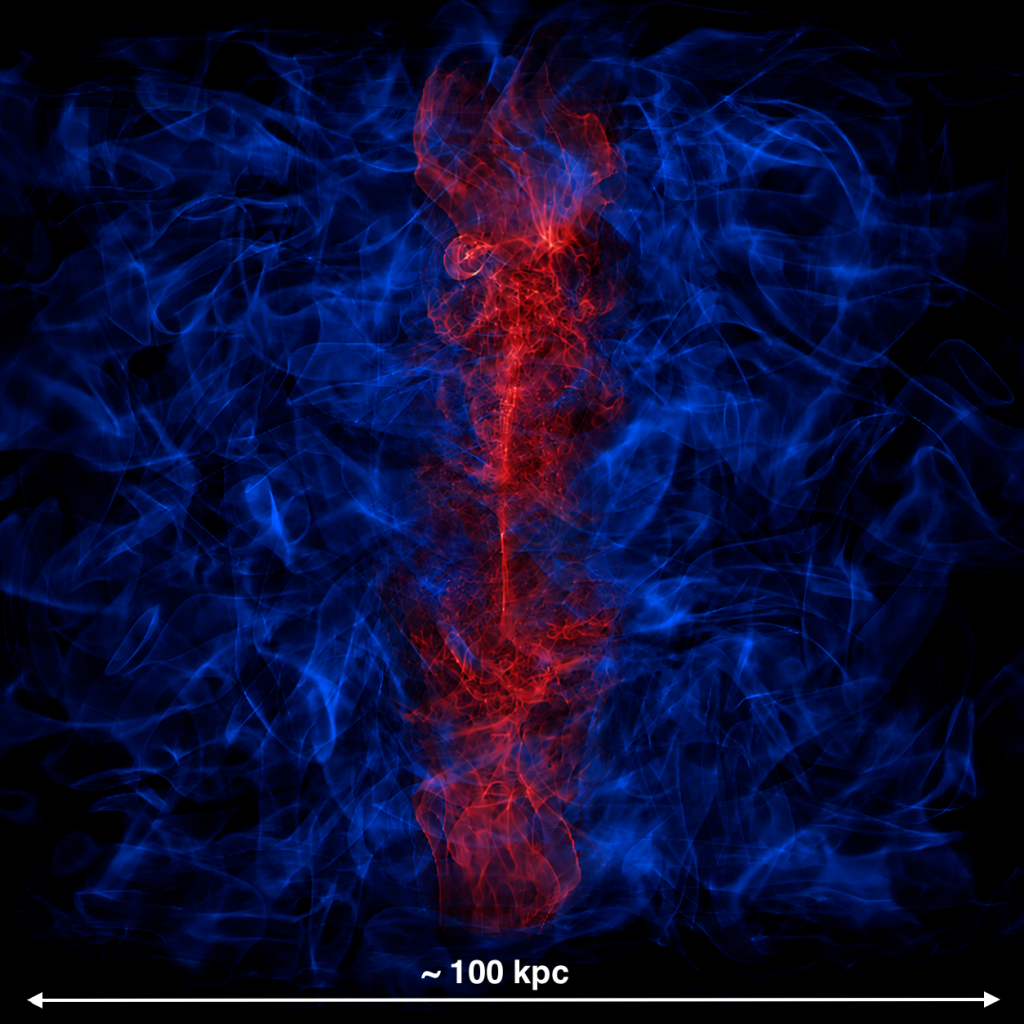
The Cosmic Weather of Black Holes
Investigating the interplay between turbulence, gas condensation, black hole feeding, and feedback.
Our science
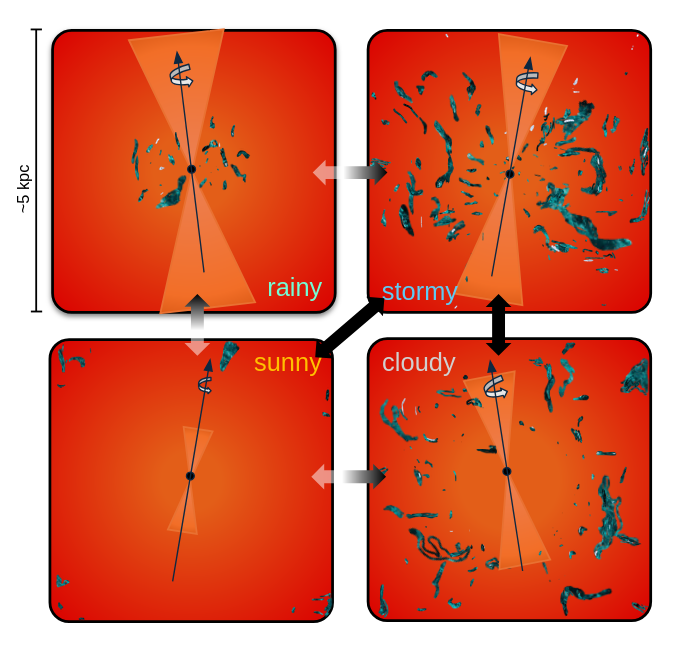
Galaxies, groups, and clusters are immersed in vast atmospheres of diffuse gas. Far from being static, these cosmic atmospheres are constantly reshaped by turbulence, radiative cooling, and black hole activity, giving rise to complex and ever-changing cosmic weather.
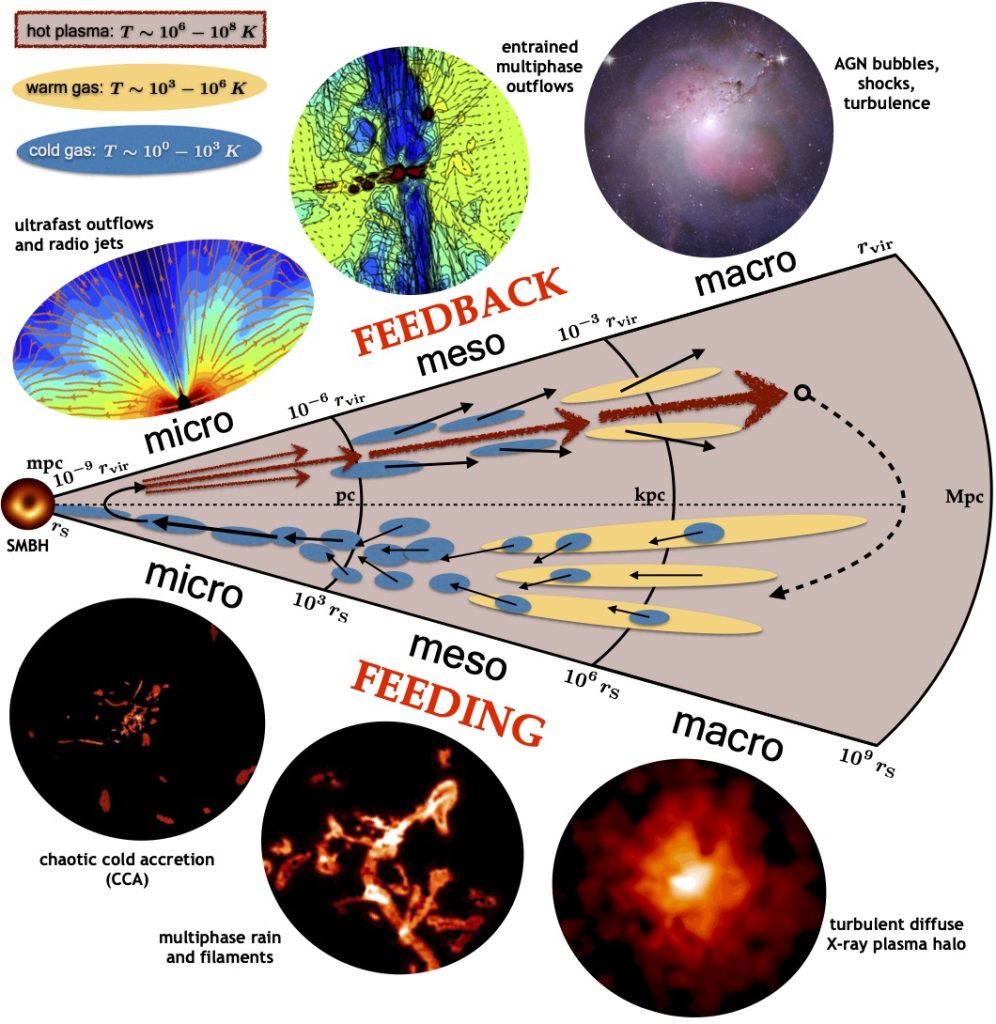
Within these atmospheres, hot gas can cool and condense into warm filaments and cold clouds. Some of this material may flow toward the central supermassive black hole through a process known as Chaotic Cold Accretion (CCA). In turn, jets, outflows, and radiation release energy back into the surrounding environment, helping regulate the gas cooling and accretion.
BlackHoleWeather aims to understand how this self-regulated feeding–feedback cycle operates across an extraordinary range of spatial and temporal scales, shaping the evolution of galaxies, groups, and clusters. To achieve this, we combine high-performance numerical simulations, fundamental gas physics, and multiwavelength astronomical observations.
Numerical Simulations
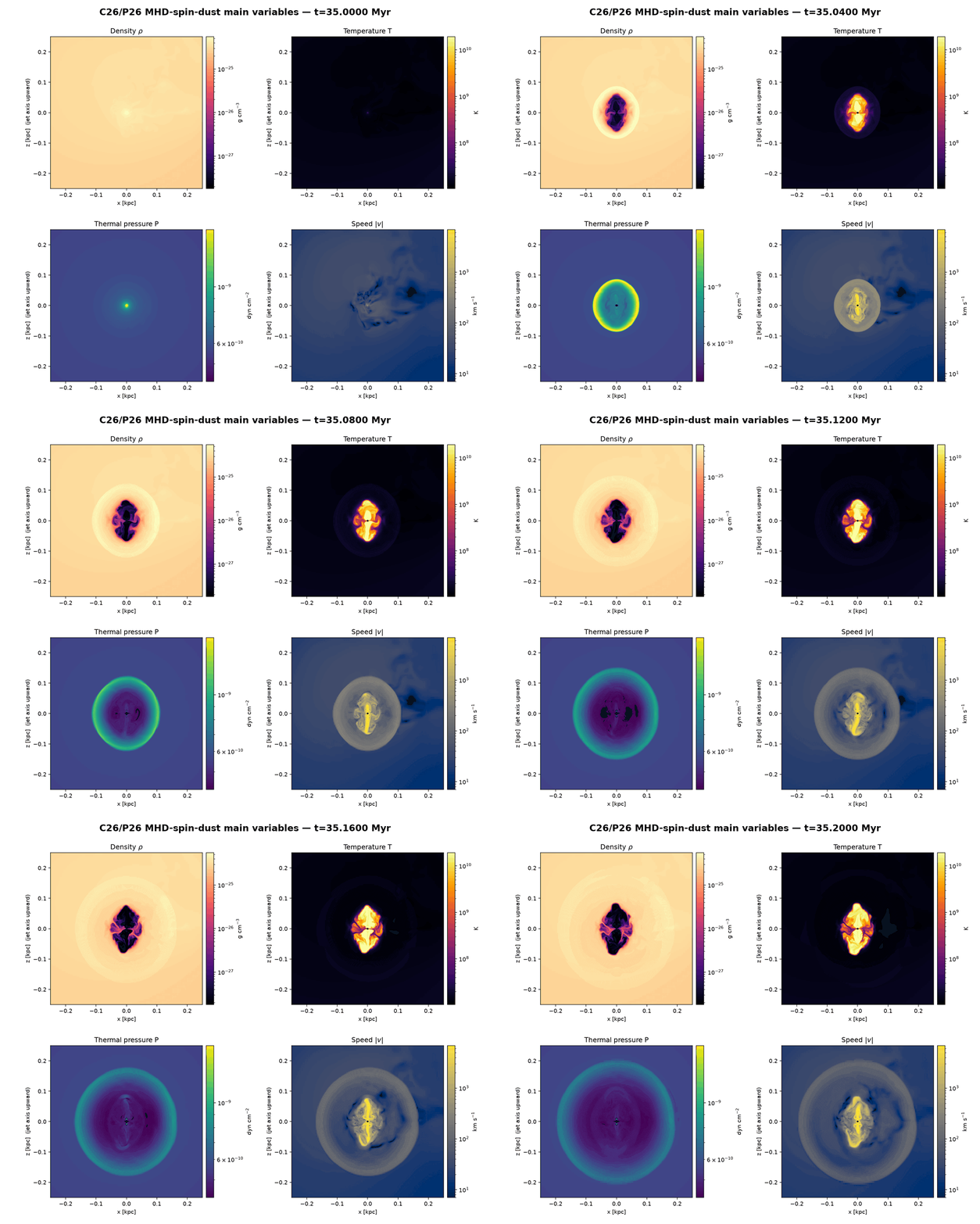
We use state-of-the-art, massively parallel numerical simulations to investigate the complex physics governing cosmic gas atmospheres and their interaction with supermassive black holes. By modeling turbulence, radiative cooling, and multiphase gas condensation, we explore how matter flows from large-scale cosmic halos toward central black holes through Chaotic Cold Accretion.
We also investigate how black-hole-driven jets, outflows, and radiation transport matter and energy back into the surrounding environment. By connecting these processes across vastly different scales, our simulations aim to reveal the physical mechanisms that establish and regulate the black hole feeding–feedback cycle.
Multiwavelength Observations
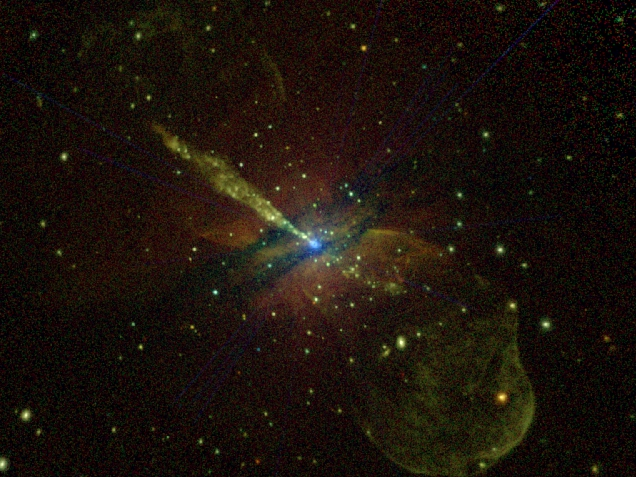
The interplay between cosmic gas and supermassive black holes leaves observable signatures across the electromagnetic spectrum. X-ray observations reveal the hot plasma permeating galaxies, groups, and clusters, while optical and ultraviolet observations trace warm ionized filaments. Infrared and radio data uncover cooler gas phases, including neutral and molecular clouds.
Combining observations from facilities such as Chandra, XMM-Newton, HST, MUSE, ALMA, JWST, and MeerKAT, we investigate the morphology, thermodynamics, and kinematics of these multiphase atmospheres. By searching for signatures of turbulence, gas condensation, accretion, and AGN feedback, we aim to constrain the physical processes governing the feeding–feedback cycle and test the predictions of numerical simulations.
Synthetic observations
Numerical simulations reveal the underlying physics, while astronomical observations show how these processes unfold in the real Universe.
By generating realistic synthetic observations from our simulations and comparing them with multiwavelength data, we can test theoretical predictions and investigate how gas condensation, black hole feeding, and AGN feedback are connected.
This synergy is central to BlackHoleWeather’s goal of developing a unified, self-consistent picture of the evolution of black holes and their host galaxies.
Explore our research
Discover our latest scientific results, research methods, and publications.